
The function and structure of exhaust gas treatment fans
Release time:
2022-10-10
The increase in pressure mainly occurs at the impeller, followed by the diffusion process. In the exhaust gas treatment fan, the airflow enters the next impeller through the recirculator, generating higher pressure. Now, let's learn about the function and structure of the exhaust gas treatment fan!
During the operation of the exhaust gas treatment fan, based on the principle of converting kinetic energy into potential energy, the high-speed rotating impeller can accelerate the gas, then decelerate and change its direction, converting kinetic energy into potential energy (pressure). In a single-stage centrifugal fan, the gas enters the impeller axially, and as it flows through the impeller, it changes radially and enters the diffuser. In the diffuser, the gas changes its flow direction, and the increase in the cross-sectional area of the duct causes the airflow to decelerate, which converts kinetic energy into pressure energy. The rise in pressure mainly occurs in the impeller and secondly during the diffusion process. In the exhaust gas treatment fan, the airflow is directed into the next impeller through a recirculator, generating higher pressure. Now, let's understand its function and structure together!Exhaust gas treatment fanLet's explore its function and structure!
1. Function of the exhaust gas treatment fan
1. Ventilation and cooling
Exhaust gas treatment fans are widely used in boilers and industrial furnaces. They mainly serve the purpose of ventilation, ensuring the environment of the boiler room and industrial kilns, while allowing oxygen-rich air to replace the air, enhancing the combustion efficiency of the boiler and kiln, which helps save coal and other power resources to some extent, reducing production costs for enterprises.
2. Ventilation, cooling, and dust removal
Centrifugal fans are installed in factories in workshops, warehouses, and other departments, serving the purpose of ventilation, ensuring fresh air in the workplace, which is beneficial for purifying the working environment and employee health. At the same time, warehouses in factories are equipped with centrifugal fans to dry the air, ensuring that machinery and other industrial products maintain their original quality. Centrifugal fans are installed in mines and tunnels to ensure air circulation, allowing fresh air to enter and polluted air to be expelled; the dust removal function of centrifugal fans ensures clear air, constructing mines and tunnels to ensure the health of mine workers and the public.
Centrifugal fans are set up in cooling towers, not only serving the purpose of ventilation to ensure the normal operation of the cooling tower but also the large airflow generated by the centrifugal fan positively contributes to improving the cooling effect of the cooling tower, providing fresh air for vehicles, ships, and buildings. Its effect is significant, promoting fresh air exchange, ensuring that vehicles, ships, and buildings regularly receive fresh air, maintaining the physical and mental health of the occupants.
3. Inflatable propulsion
Exhaust gas treatment fanArtificial air sources can be created on membranes, for filming and other air needs, but without natural wind. Centrifugal fans utilize their characteristics to create artificial wind. Centrifugal fans can inflate objects like air-cushion boats or propel high-speed air-cushion boats.
4. Household ventilation and cooling
In daily life, many household appliances are equipped with centrifugal fans, and household air conditioning systems also use centrifugal fans. These machines serve the purpose of heat dissipation and ventilation, circulating air to make hot summers fresh and cool, keeping indoor air dry and fresh. This helps reduce the incidence of colds, respiratory diseases, and other illnesses.
2. Structure of the exhaust gas treatment fan
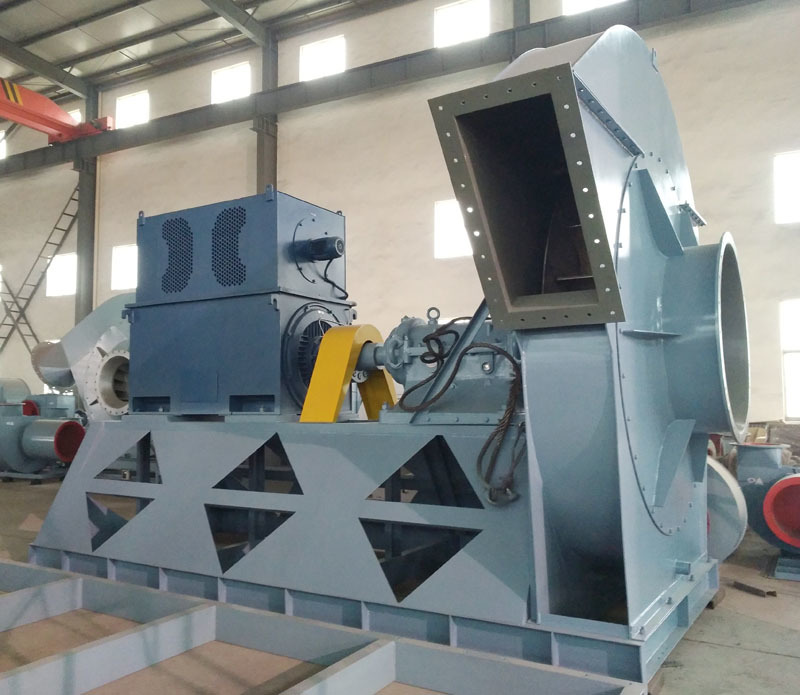
The exhaust gas treatment fan consists of a casing, main shaft, impeller, bearing transmission mechanism, motor, etc. The casing: made of steel plates, is sturdy and reliable, and can be divided into integrated and semi-open types, with the semi-open type being convenient for maintenance.
Impeller: consists of blades, a curved front disc, and a flat rear disc.
Rotor: needs to maintain static and dynamic balance to ensure stable rotation and good performance.
Transmission part: consists of the main shaft, bearing box, rolling bearings, and pulleys (or couplings).
3.Exhaust gas treatment fanPerformance characteristics
The exhaust gas treatment fan is essentially a variable flow constant pressure device. Under a constant speed, the pressure-flow theoretical curve of the exhaust gas treatment fan should be a straight line. Due to internal losses, the actual characteristic curve is curved. The pressure generated by the exhaust gas treatment fan is greatly affected by changes in intake temperature and density. For a given intake volume, the pressure generated at high intake temperatures (lower air density) is lower. For a given pressure and flow characteristic curve, there exists a power and flow characteristic curve. When the fan operates at a constant speed, for a given flow rate, the lower the intake temperature, the higher the required power.
Related News

Tel: 0510-87601805
E-mail: shenhong@zt-fan.com
Address: No. 2, Wendong East Road, Industrial Concentration Zone, Xushe Town, Yixing City, Jiangsu Province (No. 58, Original East Road)

Scan QR code
Plus WeChat
Copyright © 2024 Jiangsu ZT Fan Co., Ltd. Business License


