
What is the difference between a blower and a mixed flow fan?
Release time:
2022-06-23
The impeller of the inclined flow fan rotates at high speed, which not only causes the air to move centrifugally but also axially, generating both the centrifugal force of a centrifugal fan and the thrust of an axial flow fan. The air movement in the casing mixes axial flow and centrifugal motion. Low-pressure centrifugal fans, medium-pressure centrifugal fans, induced draft fans, or mixed flow fans are generally used as pressurizing blowers in smoke control systems.
Induced draft fanor medium and low pressure centrifugal fans are used for mechanical pressurized air supply.
Today, a student asked me about the difference between an induced draft fan and a mixed flow fan, so I have organized the following for everyone:
Different working principles.
1. Centrifugal fan.
The axial inlet of the air fan draws in airflow, which enters the impeller through a 90° bend. The gas in the gap between the impellers is driven and rotated to gain centrifugal force. Due to the effect of centrifugal force, the gas is collected from the volute casing and guided along the cut to the exhaust port, generating a certain positive pressure. As the gas exits, a negative pressure is formed in the impeller, continuously drawing gas from the axial inlet, thus forming a continuous process of intake, pressurization, and exhaust.
2. Induced draft fan.
Induced draft fanWhen the impeller rotates, gas enters the impeller axially from the intake duct, driven by the blades on the impeller, adding energy to the gas, which then flows into the guide blades. The guide blades deflect the gas flow towards the axial flow, while the gas is directed into the diffuser, further converting the kinetic energy of the gas into pressure energy, leading into the working pipe.
3. Mixed flow fan.
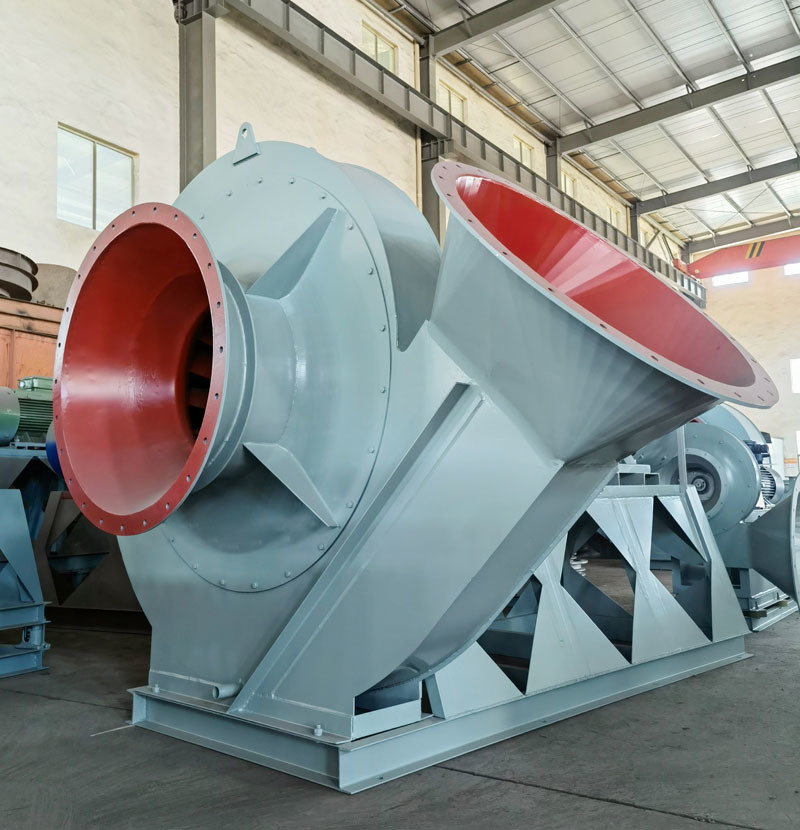
The shape and structure of the mixed flow fan (also known as the oblique flow fan) are located between the centrifugal fan and the axial flow fan. It is a fan that combines features of both axial flow and centrifugal fans. The impeller of the oblique flow fan rotates at high speed, causing the air to move both centrifugally and axially, generating not only the centrifugal force of the centrifugal fan but also the thrust of the axial flow fan, mixing the air movement in the casing with both axial and centrifugal motion.
Different concepts.
Axial flow is when the gas flows parallel to the axis of the fan, such as in an electric fan. The casing has an open inlet and a right-angle bend shape, allowing the motor to be placed outside the duct.
The impeller of the mixed fan allows the air to undergo both centrifugal and axial motion simultaneously. The movement of air in the casing combines two forms of motion: axial flow and centrifugal flow, hence it is called mixed flow.
Different product characteristics.
The wind pressure coefficient of the mixed flow fan is high, and the flow coefficient is larger than that of the centrifugal fan. It effectively fills the gap between axial flow and centrifugal fans.
The mixed flow fan combines the characteristics of the induced draft fan and the centrifugal fan, resembling a traditional axial flow fan more closely. The casing can have an open inlet, but more often it has a right-angle bend shape, allowing the motor to be placed outside the duct.
YFISD-D mixed flow fan casing.
II) Differences.
Comparison of dimensions and speeds of centrifugal, axial, and mixed flow fans:
(1) Pressure: Centrifugal fan > Mixed flow fan.
(2) Air supply volume: Mixed flow fan > Centrifugal fan.Induced draft fan.
III. Summary.
Low pressure centrifugal, medium pressure centrifugal, induced draft fans, or mixed flow fans are generally used as pressurized air supply fans in smoke prevention systems.
Centrifugal fans or mixed flow fans are generally used as smoke exhaust fans in smoke exhaust systems.
The difference between smoke exhaust fans and pressurized air supply fans is that under 280° conditions, the low workload of smoke exhaust fans should be continuous for 30 minutes.
Related News

Tel: 0510-87601805
E-mail: shenhong@zt-fan.com
Address: No. 2, Wendong East Road, Industrial Concentration Zone, Xushe Town, Yixing City, Jiangsu Province (No. 58, Original East Road)

Scan QR code
Plus WeChat
Copyright © 2024 Jiangsu ZT Fan Co., Ltd. Business License


