
Installation and Maintenance of High-Temperature Fans
Release time:
2022-04-12
High-temperature fans are widely used in industries such as steel metallurgy, chemical engineering, and power generation. Compared to standard temperature fans, high-temperature fans have a higher failure rate and shorter lifespan, and they have relatively high technical requirements for installation and maintenance, making them more difficult to handle. Mistakes during installation and maintenance processes have led to failures such as bearing burnouts and excessive fan vibrations. Now, let's learn about the installation and maintenance of high-temperature fans!
High-temperature fans are widely used in industries such as steel metallurgy, chemical engineering, and power generation. Compared to normal temperature fans,High-temperature fanthey have a higher failure rate, shorter lifespan, and relatively higher technical requirements for installation and maintenance, making them more difficult to handle. Mistakes during installation and maintenance can lead to failures such as bearing burn-out and excessive vibration of the fan. Now, let's learn about the installation and maintenance of high-temperature fans!
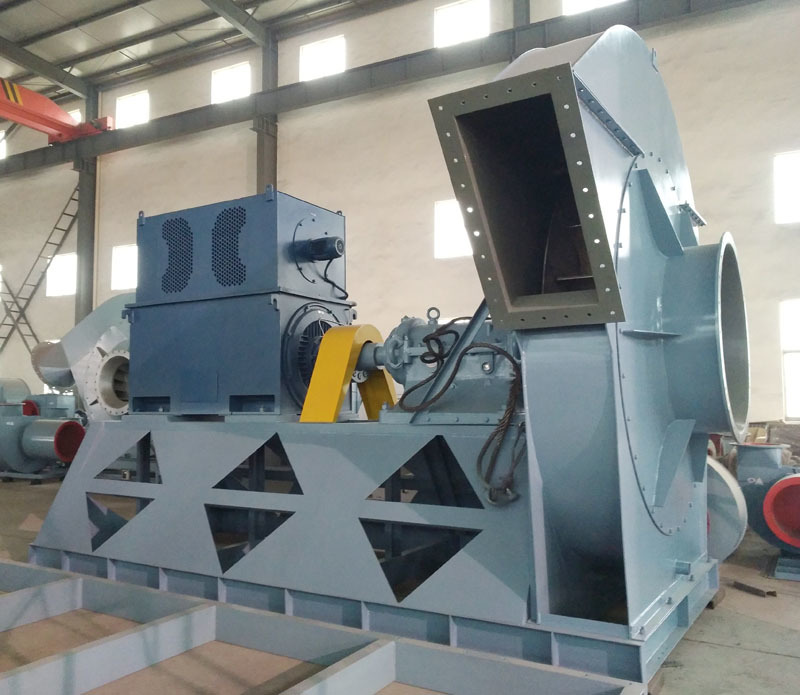
1. Installation and debugging of high-temperature fans
1. Installation of the main shaft of the high-temperature fan
High-temperature fanThe thermal expansion of the main shaft is achieved through the axial movement of the non-locating end bearing. The design considers the thermal expansion of the main shaft casing, and the installation drawings usually indicate the positioning dimensions for the casing and impeller. Issues to pay attention to during on-site installation include: (1) Select the load end as the locating end based on the direction of the shaft expansion; (2) Determine the locating and non-locating bearing seats based on the differences in end caps.
2. Correct alignment of the system
The alignment of the high-temperature fan system mainly includes the central alignment of the casing and the alignment of the fan shaft and motor. To avoid 'false alignment' in a heated state, the alignment of various parts of the high-temperature blower must be performed at room temperature.
3. Installation of the lubrication station
The lubrication station for the high-temperature fan should not be too far from the casing to avoid high-temperature environments. If the lubrication station is too far away, the supply and return oil pipes will be longer, increasing the loss of oil flow and leading to insufficient oil supply pressure, insufficient return oil, and oil leakage from the casing. This is especially likely to occur during cold starts in winter.
4. Test run
High-temperature fanThe medium density at room temperature is much greater than the actual situation. Therefore, the cold test run of the high-temperature fan must have the intake damper closed. Otherwise, it may fail to start normally due to excessive current or damage to the vehicle caused by the load of the hydraulic coupler.
2. Diagnosis and handling of common faults
Vibration of high-temperature fans
Excessive vibration is a common fault during the operation of hot air fans and is an important factor affecting the safe operation of the fan and normal production in the factory. There are many causes of fan vibration, with common reasons including rotor imbalance, poor system alignment, looseness, friction between moving and stationary parts, rolling bearing failures, rotor bending, resonance, and motor faults causing fan vibration.
Causes and handling methods for rotor imbalance
Rotor imbalance is a common cause of excessive fan vibration. The characteristics of simple rotor imbalance vibration are obvious: 1) The waveform is close to a sine wave; 2) In the spectrum, harmonic energy is mainly concentrated at the fundamental frequency. Due to the special working environment of hot air fans in sintering plants and pellet plants, the factors leading to rotor imbalance are also relatively complex.
High bearing temperature
High bearing temperature is also a common fault during fan operation, with many causes, but for high-temperature fans, it mainly includes six aspects.
1) Severe bearing wear, with excessive axial and radial clearance. This is mainly due to the long service life of the bearing, with severe wear of the balls and cages, requiring replacement.
2) Insufficient or excessive lubrication oil. Hot air fans are mostly lubricated by circulating oil, and the hydraulic pressure and oil temperature of the lubrication station have a significant impact on the temperature of the bearing seat. Generally, the oil supply pressure for the thin oil station is 0.15~0.2MPa, and the oil supply temperature should not exceed 40 degrees. Please clean the oil filter regularly. At the same time, the oil supply and return pipes should not be too close to the casing to avoid the influence of ambient temperature radiation on oil temperature.
3) Deterioration or different types of lubrication oil, with too low or too high viscosity. Generally, the lubrication oil for high-temperature fans should be replaced every six months, with types suitable for 32# or 46# (or strictly according to the equipment manual requirements for selecting lubrication oil).
4) Excessively high ambient temperature. The temperature of the fan casing varies greatly with ambient temperature, and unstable process operations lead to unstable wind temperatures, which is a common issue affecting casing temperature.
5) Installation errors. Due to the eccentric installation of the bearings at both ends and the installation position errors of the main shaft, the gap between the non-locating end casing end cap and the bearing outer ring becomes too small. After the main shaft expands due to heat, friction between the bearing outer ring and the end cap can lead to bearing heating.
6) Friction between the rotation of the bearing outer ring and the inner hole of the bearing housing.
The above introduces the installation and maintenance of high-temperature fans. If you need to know more, feel free to contact us!
Related News

Tel: 0510-87601805
E-mail: shenhong@zt-fan.com
Address: No. 2, Wendong East Road, Industrial Concentration Zone, Xushe Town, Yixing City, Jiangsu Province (No. 58, Original East Road)

Scan QR code
Plus WeChat
Copyright © 2024 Jiangsu ZT Fan Co., Ltd. Business License


