
How to choose exhaust gas treatment fans
Release time:
2021-11-06
In order to appropriately select the airflow of exhaust treatment fans, it is generally calculated and designed by technical personnel. In the countermeasures for organic exhaust pollution, the first step is to calculate the content of the main gases based on the types of exhaust emitted by the enterprise, such as benzene and other gases, and then calculate based on their content and the amount of gas produced. Secondly, it is necessary to measure the length, width, and height of the exhaust emission space, which serves as the theoretical calculation basis. Now, let's understand how to choose exhaust treatment fans!
SelectionExhaust gas treatment fanWhen selecting, it is necessary to consider the effective collection of gases. If the air volume is too small, it cannot collect the gas. If the air volume is too large, it wastes energy, and if the air pressure is too high, it will carry away the absorbent from the outlet. In any case, to appropriately select the air volume of the exhaust gas treatment fan, it is generally calculated and designed by technicians. In the case of organic exhaust gas pollution control, the main gas content is first calculated based on the types of exhaust gases discharged by the enterprise, such as benzene and other gases, and then calculated based on their content and the amount of gas produced. Secondly, it is necessary to measure the length, width, and height of the exhaust emission space, which serves as the theoretical calculation basis. Now, let's understand how to select the exhaust gas treatment fan!
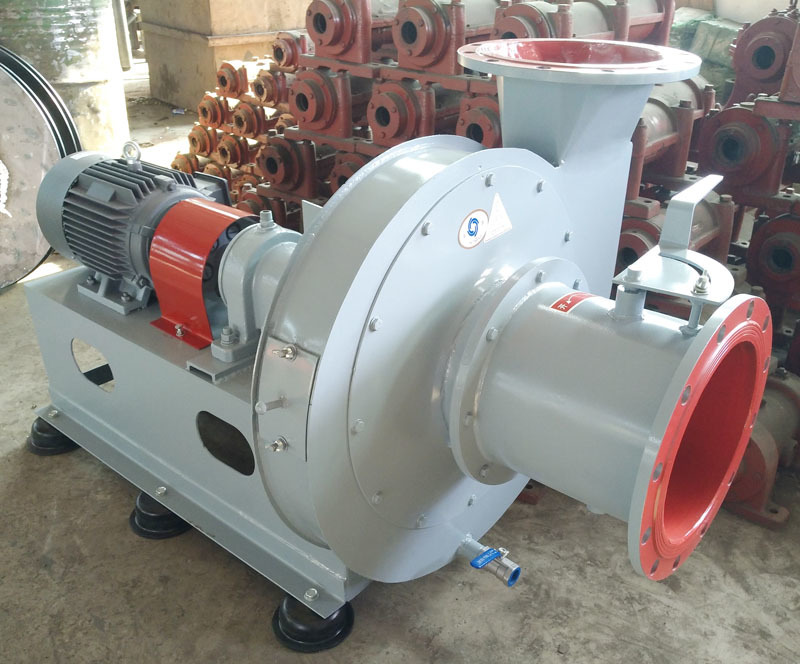
SelectionExhaust gas treatment fanWhen selecting, two parameters need to be determined. One is the air volume of the blower, and the other is the air pressure of the blower. After determining these two parameters, the specific type of blower can be determined. The blower's capacity to discharge a certain number of cubic meters of exhaust gas per hour is the amount of exhaust gas we need to treat. This is calculated based on actual conditions and cannot be generalized. The calculation method varies by industry. Air pressure refers to the magnitude of the exhaust force of the blower. This is related to the length of the exhaust duct (where pressure loss occurs in pipes and elbows) and the wind resistance of the equipment, which needs to be calculated.
In fact, calculating the air volume of the exhaust gas treatment fan should still be combined with real conditions. Frequently using calculation formulas and experiences from data without a theoretical basis is incorrect. For example, how much air volume is needed to handle an exhaust emission space that is 3 meters high, wide, and long? It depends on what kind of suction ventilation mode is suitable for your site. Generally, there are three suction modes. The first is a completely sealed type, and the calculation method recorded in books is correct. That is, volume * air change rate = air volume. Specifically, 3 * 3 * 3 * 60 = 1620m3/h. The second is a ceiling suction hood, with an air change rate of 100 times, and during smoking, the air change rate is less than 200 times. The third is a side intake hood, with an air change rate of as low as 150 times, and during smoking, the air change rate is as low as 300 times. This also follows the currently more accurate calculation method.
SelectionExhaust gas treatment fanThe air volume and air pressure are very important. After calculating the air volume, the exhaust gas treatment equipment generally has wind resistance, which varies depending on the equipment. For example, the wind resistance of an activated carbon adsorption box is much greater than that of a photocatalytic oxidation device, so air pressure is very important. Otherwise, the blower may not be able to directly draw in the exhaust gas.
As mentioned above, the early stage of the exhaust gas treatment project requires a lot of information collection, analysis, and summarization work. There are many engineers and designers in the environmental industry with rich experience in exhaust gas and wastewater treatment, who conduct analysis based on actual conditions such as industry, situation, and types of pollutants through data analysis and field investigations.
The above introduction is about how to select the exhaust gas treatment fan. If you need to know more, feel free to contact us!
Related News

Tel: 0510-87601805
E-mail: shenhong@zt-fan.com
Address: No. 2, Wendong East Road, Industrial Concentration Zone, Xushe Town, Yixing City, Jiangsu Province (No. 58, Original East Road)

Scan QR code
Plus WeChat
Copyright © 2024 Jiangsu ZT Fan Co., Ltd. Business License


