
What are the causes of high-temperature fan vibration and the measures to address them?
Release time:
2021-12-15
The model of the high-temperature fan at the kiln tail of a certain company's 1000t/D production line is W6-2×29-46№ 21.5F, with a typical speed of 1000~1200r/min. The allowable values for bearing vibration of the high-temperature fan are: amplitude 0.198mm, vibration speed 11mm/S; the alarm temperature for the bearing is 75℃, and the shutdown temperature is 95℃; the alarm temperature for the hydraulic coupler oil output is 80℃, and the shutdown value is 85℃. The bearing housing has experienced significant vibration multiple times during production. Initially, this was mainly caused by poor ventilation in the fan pipeline.
1. Introduction
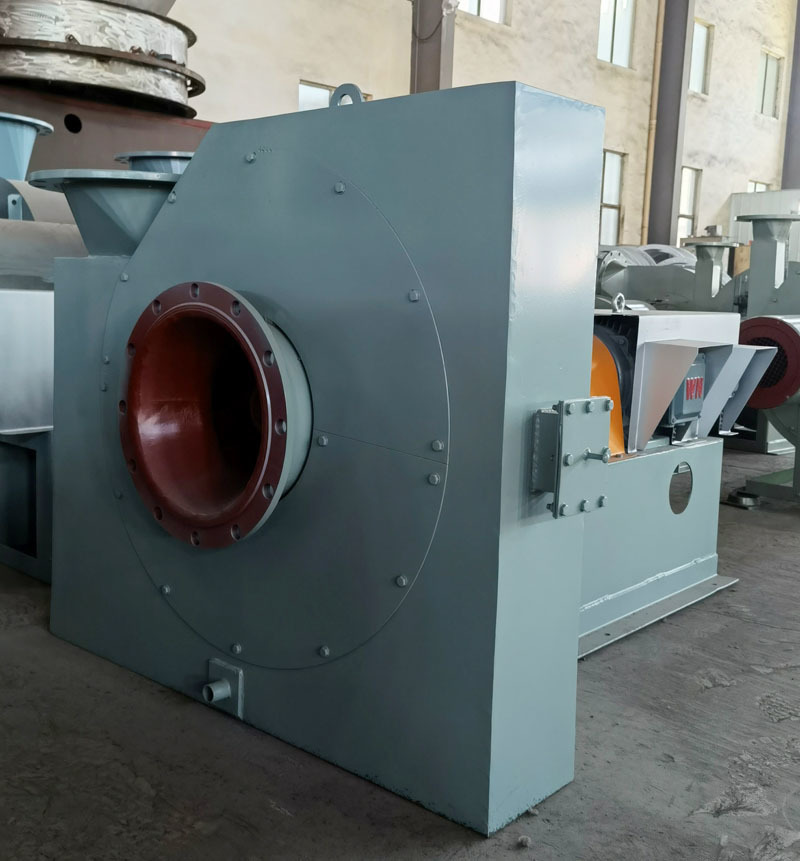
Kiln tail of a certain company's 1000t/D production lineHigh-temperature fanModel w6-2×29-46№ 21.5f, with a speed generally between 1000~1200r/min. The allowable value for bearing vibration is: amplitude 0.198mm, vibration speed 11mm/S; bearing temperature alarm value is 75℃, shutdown at 95℃; hydraulic coupler oil temperature alarm value is 80℃, shutdown value is 85℃. The bearing seat has experienced significant vibration multiple times during production. Initially, this was mainly due to poor ventilation in the fan pipeline.
After multiple shutdown inspections, the coupling alignment was normal, and the bearing clearance was about 0.10mm, which is also within the normal range. The hydraulic coupler and motor vibrations were not significant, and there was little dust accumulation on the fan blades, but the blade wear was uneven. Some front blades were only about 5mm thick, while some rear blades were 7mm thick (the standard thickness is 8mm), leading to suspicion that uneven blade wear caused the impeller imbalance. However, sometimes, without any treatment, the vibration values of the high-temperature fan returned to normal after a restart, and would suddenly increase after running for a period. Therefore, we conducted a field dynamic balance on the high-temperature fan and identified the reasons for the significant vibration after two treatments.
2. Causes of high-temperature fan vibration and treatment measures
(1) First dynamic balance treatmentHigh-temperature fanIn mid-October 2010, the first on-site dynamic balance was performed. Due to significant vibration, the vibration meter originally installed on the bearing seat could not accurately measure the amplitude, so it was removed and a handheld vibration meter was used for measurement. The cooling blades at both ends of the fan casing were removed, and the fan speed was adjusted to 1300r/min. The horizontal vibration value of the motor end bearing seat (referred to as the front end, the same below) was measured at 20mm/s, and the horizontal vibration value of the slow-turning end bearing seat (referred to as the rear end, the same below) was 25mm/s. The machine was then shut down, and the shaft at the positions of the cooling blades at both ends was blackened with an oxyacetylene flame. The fan was started, and the speed was adjusted to 1300 R/min. A sharp scraping needle was slowly brought close to the blackened shaft until scratches appeared between the scraping needle and the shaft. The machine was shut down, and the arc length of the scratches was measured to find the midpoint of the arc. A 60mm steel plate was welded to the impeller corresponding to the midpoint of the scratches at the front end ×60mm×10mm steel plate (approximately 300g). After welding, the fan was started to 300r/min, and the front end horizontal vibration value was measured at 13.4mm/s, and the rear end horizontal vibration value was 18.5mm/s. A 60mm piece was welded to the midpoint of the rear end scratch on the impeller ×60mm×10mm steel plate, and the front end horizontal vibration value was measured at 5.1mm/s, and the rear end horizontal vibration value was 8.9mm/s. Subsequently, 30mm×30mm×10mm steel plates were welded on both sides of the rear welding block, and the front end horizontal vibration value was measured at 5.4mm/s, and the rear end horizontal vibration value was 6.2mm/s, which basically met the requirements. Therefore, the vibration meter was installed on the bearing seat to adjust and measure the speed and vibration values, as shown in Table 1. The data in the table indicates that the adjustment was successful. High-temperature fan
(2) Second dynamic balance treatment
About half a month after normal operation, significant vibration occurred again. At a speed of 1219r/min, the front end amplitude was 0.277mm, and the rear end amplitude was 0.131mm, with the hydraulic coupler oil temperature at 55.3℃. At a speed of 1300r/min, the front end horizontal vibration value was 40 mm/s, and the rear end was 20 mm/s, which was greater than before the first dynamic balance. Therefore, in early November 2010, on-site dynamic balance was performed again, with three balances conducted, each time welding a 60mm×60mm×10mm steel plate at different locations. However, after welding, the position of the unbalanced point changed each time, and the vibration values did not change significantly.
正常运行约半个月后,再次出现较大振动,转速为1219r/min时,前端振幅为0.277mm,后端振幅为0.131mm,液力偶合器出油温度为55.3℃;转速为1300r/min时,前端水平振动值为40 mm/s,后端20 mm/s,大于一次动平衡前,故于2010年11月初再次进行现场动平衡,进行了三次平衡,每次在不同部位焊接一块60mm×60mm×10mm钢板,但焊接后配重each次,不平衡点位置变化,振动值变化不大。
Related News

Tel: 0510-87601805
E-mail: shenhong@zt-fan.com
Address: No. 2, Wendong East Road, Industrial Concentration Zone, Xushe Town, Yixing City, Jiangsu Province (No. 58, Original East Road)

Scan QR code
Plus WeChat
Copyright © 2024 Jiangsu ZT Fan Co., Ltd. Business License


